Aswan & Abu Simbel: The Complete Travel Guide
Welcome to the complete travel guide to Aswan and Abu Simbel, the most evocative corner of Upper Egypt. For travellers who push south of Luxor, beyond the fertile Nile valley and into the golden desert, the reward is a pair of destinations many consider the highlight of any trip to Egypt. Aswan is a slow-moving, palm-shaded river city where Nubian culture flourishes and sandstone temples rise from granite islands. Sixty kilometres further south, along the vast Lake Nasser reservoir, the colossal rock-cut temples of Abu Simbel stand as the ultimate monument to the pharaoh Ramses II. Together, Aswan and Abu Simbel offer ancient history, natural scenery, and adventure in perfect measure. This guide covers everything you need: the best things to do in Aswan, the story of Philae Temple, the High Dam and the Unfinished Obelisk, Nubian village life, the felucca sail, the astonishing rescue of Abu Simbel in 1968, the Sun Festival, and practical details on getting there and combining it with a Nile cruise to Luxor.
Why Visit Aswan and Abu Simbel
Most Nile itineraries begin in Cairo and cruise south to Luxor, but the true heart of pharaonic Upper Egypt lies even further south. Aswan is the frontier city where ancient Egypt met the kingdom of Nubia, and where the river broadens into a landscape of islands, date palms, and rose-tinted granite. It is Egypt at its most relaxed: slower, hotter, and more mysterious than the crowded temples of Karnak or the busy streets of Cairo, and that gentle tempo — afternoon felucca sails, spice-scented souks, tea shared with Nubian families — is part of the attraction.
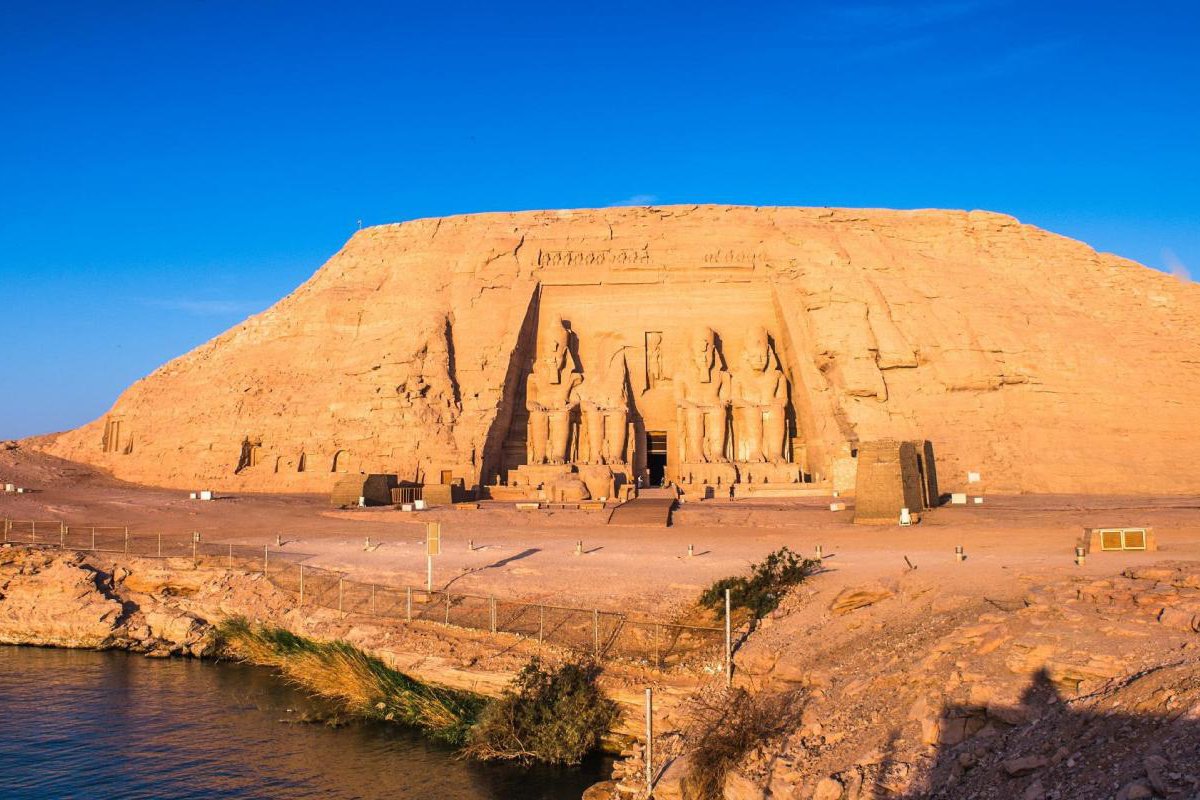
Abu Simbel is the reason many travellers make the long journey south. The Great Temple of Ramses II, carved into the living rock of the Nubian desert, is one of the most recognisable monuments on Earth, its four colossal statues of the seated king guarding the entrance for more than three thousand years. Aswan and Abu Simbel are inseparable in practice: nearly every visitor to one also visits the other, normally combined in a single long day trip or a two-night stay. Whether you reach Abu Simbel by road, by air, or by cruise boat across Lake Nasser, the journey is as memorable as the destination.
Aswan at a Glance
Aswan is Egypt's southernmost major city, lying roughly 880 kilometres south of Cairo on the east bank of the Nile. For much of its history it was a trading gateway and a military outpost rather than a royal capital, and that frontier character still shows. The city is small and walkable, with a relaxed atmosphere that has drawn writers for two centuries; Agatha Christie wrote parts of "Death on the Nile" here. The island of Elephantine, opposite the corniche, was the site of the earliest settlement and gave the city its ancient name, Swenet, meaning "the market".
Aswan sits at the first cataract of the Nile, the stretch of rapids and granite boulders that historically marked the southern border of Egypt. The cataract itself has been largely submerged by the dams, but the granite outcrops still shape the landscape, and the old quarries that supplied Egypt's greatest temples are still visible. This is also the land of the Nubian people, whose villages line both banks and whose warm hospitality is one of the great pleasures of a visit. For all of these reasons, Aswan deserves far more than a whistle-stop; most travellers who spend a day here wish they had spent three.
Old Aswan and the Corniche
The heart of modern Aswan is the corniche, a long palm-lined promenade along the east bank of the Nile. In the late afternoon, when the heat softens and the light turns amber, it comes alive with families, street vendors, and the masts of moored feluccas. Beyond the waterfront, the souk on El-Souk Street is the best place to shop for spices, perfumes, galabeyas, and handcrafted Nubian baskets and jewellery. The old town between the souk and the river is a maze of ochre alleys, cafés, and shisha bars, perfect for getting lost for an hour.
Across the river, the island of Elephantine holds the ruins of ancient Swenet, including temples to Khnum, the ram-headed creator god, and the famous Nilometer, a stairway of stone steps used to measure the annual flood. On the island's southern tip, the Nubian villages of Koti and Siou offer a glimpse of traditional life. Directly opposite, the whitewashed mausoleum of the Aga Khan rises from the desert hillside, glowing at sunset. The best way to appreciate this scatter of islands is from the water — which brings us to the feluccas. First, however, let us look at the unmissable sights of the city itself.
When to Visit Aswan and Abu Simbel
Aswan is one of the driest and hottest cities on Earth, and the best visiting season runs from October to April, when daytime temperatures are pleasant and nights are cool. December and January are the most popular and busiest months, so book well ahead. From May to September the heat is intense, with midday temperatures regularly above 40 degrees Celsius, though the crowds vanish and hotel prices drop. The mild shoulder months of March and November offer a fine balance of good weather and fewer crowds.
One date matters above all others for a visit to Abu Simbel: the twice-yearly Sun Festival. On the 22nd of February and the 22nd of October each year, the rising sun illuminates the inner sanctuary of the Great Temple, and thousands of visitors travel to witness it. If you want to see the festival itself, book many months in advance; if you prefer a quieter experience, avoid these dates entirely. The temples are open from around 5am to 6pm daily, and early morning is by far the best time to visit, both for the light and to beat the crowds and the heat.
Top Things to Do in Aswan
Aswan packs an extraordinary amount of history into a small area, and its sights are among the most beautiful in Egypt. The essential experiences are covered below, and each is easy to reach on foot, by car, or by boat from the centre of town.
Philae Temple and Agilkia Island
Of all the temples of Egypt, Philae is perhaps the most photogenic. Dedicated to the goddess Isis, one of the most beloved deities of the ancient world, the temple complex now stands on Agilkia Island, reached only by boat. In antiquity the temples stood on the larger island of Philae, and the cult of Isis there was one of the last bastions of the old religion: it remained active until around the sixth century AD, long after Egypt had become Christian.
The first glimpse of Philae from the water is breathtaking. The temple rises from its granite island, its pylons and colonnades reflected in the still water. You approach by a short motorboat ride from the quay at the base of the old dam; as the boat draws in, the enormous first pylon comes into view, decorated with reliefs of Ptolemy XII smiting his enemies. Beyond lies the colonnaded forecourt, a graceful double row of columns with carved floral capitals, and beyond that the hypostyle hall and sanctuary, whose reliefs are remarkably well preserved — including famous scenes of Isis suckling the infant Horus.
Philae was saved from drowning by one of the great salvage operations of the twentieth century. After the first Aswan Dam was completed in 1902, the island was flooded for part of each year and visitors sailed through the half-submerged colonnades; the High Dam threatened it permanently. UNESCO then sponsored a project to move the temple, stone by stone, to the higher island of Agilkia, landscaped to resemble the original setting. The work took nine years, from 1972 to 1980, and the temple was reassembled exactly as it had stood for nearly two thousand years. It is a superb introduction to Ptolemaic temple architecture.
The High Dam
A few kilometres upstream from Philae stands the Aswan High Dam, one of the largest engineering projects of the twentieth century. Built between 1960 and 1970 with Soviet assistance, the dam is 3,830 metres long, 111 metres high, and 40 metres thick at its crest, and it holds back the Nile to create Lake Nasser, one of the largest man-made lakes on Earth. The dam ended the annual flood, provided hydroelectric power for the whole country, and allowed a dramatic expansion of irrigated farmland. It also gave rise to the great rescue of the monuments that would otherwise have been lost beneath the waters.
For the visitor, the High Dam is a brief but fascinating stop. From the eastern end there are sweeping views across Lake Nasser, its blue-green water stretching south into the horizon, and north towards the old dam and the islands of the cataract. The sheer scale of the structure is the real spectacle, best appreciated from the viewing platform. A short drive away, the "Friendship Memorial" commemorates the Egyptian–Soviet cooperation that built it. Forty minutes here is ample — the real wonders lie further along the road.
The Unfinished Obelisk
One of the strangest and most instructive sights in Egypt lies in the ancient granite quarries close to the centre of Aswan. This is the Unfinished Obelisk, a colossal block of pink granite that would have been the largest obelisk ever raised — roughly 42 metres long and an estimated 1,200 tonnes — had it been finished. A crack appeared in the granite while it was still being cut, and the project was abandoned over three thousand years ago.
The Unfinished Obelisk is more than a curiosity; it is a window into the techniques of ancient Egyptian stonework. Walking its length, you can see the deep trenches where workers pounded the rock with dolerite balls to cut it free. Standing beside it, you appreciate the astonishing scale of Egyptian engineering. The site also shows the distinctive rose granite of Aswan, the same stone used for the Colossi of Memnon and the obelisks of Karnak. Allow thirty minutes for the visit.
The Nubian Museum
To understand the people of the river, spend an hour at the Nubian Museum, one of the finest museums in Egypt. Opened in 1997 on a hillside near the Unfinished Obelisk, it tells the story of Nubia from prehistoric times to the present day, with particular focus on the region flooded to create Lake Nasser. The galleries hold extraordinary artefacts — statues, jewellery, pottery, and everyday objects — displayed chronologically with excellent labelling in Arabic and English.
The museum also gives a voice to the Nubian communities whose homelands now lie beneath the lake. When the High Dam was built, some one hundred thousand Nubians were relocated, and the museum documents their traditions, crafts, houses, and music. The outdoor section is a delight, with artificial caves, a water garden, and rescued rock art. Together with a visit to a Nubian village, it provides a complete picture of Nubian heritage — and a wonderfully cool escape from the midday heat.
Nubian Villages on the West Bank
No visit to Aswan is complete without time in a Nubian village. The most accessible is Gharb Soheil on the west bank, reached by a short motorboat ride across the Nile. As you approach, houses painted in vivid blues, yellows, and greens rise up the hillside, and drumming and singing drift across the water. The Nubian people, who have lived along the Nile for thousands of years, are famous for their hospitality, and the villages offer a wonderfully warm introduction to their culture.
On a typical visit you will be welcomed into a family home, served sweet black tea or hibiscus juice, and shown the brightly decorated rooms with their painted arches and patterned walls. Some homes keep mummified crocodiles by the door as a traditional symbol of protection. The village also has workshops where women weave baskets and make beaded jewellery. In the evening, a visit can end with music or a meal of Nubian dishes. It is an easy, rewarding half-day trip and a strong antidote to temple fatigue.
| Attraction | What to See | Time Needed |
|---|---|---|
| Philae Temple | Isis temple, colonnaded forecourt, rescue-relocation story, boat approach | 1.5 to 2 hours |
| Aswan High Dam | Lake Nasser views, monument scale, Friendship Memorial | 30 to 45 minutes |
| Unfinished Obelisk | Ancient granite quarry, cutting marks, colossal abandoned monolith | 30 to 45 minutes |
| Nubian Museum | Prehistoric to modern Nubian artefacts, reliefs, garden | 1 to 1.5 hours |
| Nubian Village (Gharb Soheil) | Painted houses, family tea, crafts, crocodile amulets | Half day |
| Elephantine Island | Khnum temple, Nilometer, Aswan Museum, Nubian villages | Half day |
| Felucca sail | Sunset on the Nile, islands, Aga Khan mausoleum | 1 to 3 hours |
| Kitchener's Island | Botanical garden with exotic trees and plants | 1 hour |
Felucca Sailing on the Nile
Ask anyone who has sailed the Nile around Aswan, and they will tell you the felucca ride is the highlight of the trip. A felucca is a traditional wooden sailing boat with tall, lateen-rigged sails, used on the Nile for centuries. Around Aswan, where the river is wide, calm, and studded with granite islands, a sail is pure magic: the boat is silent except for the lap of the water, the wind fills the triangular sail, and the world slows to the pace of a drifting cloud.
A typical sail lasts one to two hours. Set out in the late afternoon, when the heat has softened, and glide past Elephantine Island, the domed tomb of the Aga Khan, and the rocky islands of the first cataract. Most sailors know exactly where to go for the best light. As the sun sinks, the granite turns rose-red and gold, the water becomes a sheet of hammered metal, and the call to prayer drifts across the city. It is one of the most serene experiences in Egypt, and well worth the very modest cost.
For a longer adventure, book a felucca for a two- or three-day cruise south of Aswan, sleeping on deck under a canopy of stars. These excursions are quieter than the mass Nile cruises and pass the ruins of Qubbet el-Hawa and the Tombs of the Nobles. A crew prepares meals on board, and the experience is deeply romantic, though facilities are basic. Whichever you choose, a felucca sail is a classic thing to do in Aswan and one you will remember long after the temples blur together.
Abu Simbel: The Temples of Ramses II
Three hours' drive south of Aswan, at the second cataract of the Nile, stand the temples that many travellers regard as the greatest in all of Egypt. The twin temples of Abu Simbel were carved into the cliffs of the Nubian desert by Ramses II, the most powerful of the pharaohs, around 1250 BC. The Great Temple is dedicated to the sun gods Ra-Horakhty, Amun, and Ptah, and to the deified Ramses himself; the smaller temple beside it honours his favourite queen, Nefertari, and the goddess Hathor. Together they are a monument to royal power without equal in the ancient world.
History of the Great Temple
Ramses II ruled Egypt for sixty-six years, built more monuments than any other pharaoh, and was not modest about his achievements. At Abu Simbel he created a temple that faced south, towards the lands of his rivals, as a statement that Egypt's power reached to the very edge of the world. The facade is dominated by four seated colossi of the king, each 20 metres high, cut from the living sandstone cliff. The faces are serene and identical, wearing the double crown of Upper and Lower Egypt, with smaller figures of the royal family ranged around their feet. Above the doorway, a niche holds the falcon-headed sun god Ra-Horakhty, and the facade is framed by a cornice of carved baboons, the animals that greet the rising sun.
The interior descends through a series of halls, each more intimate than the last. The entrance leads into a great pillared hall supported by eight columns in the form of the king, its walls covered with battle reliefs, including the famous scenes of the Battle of Kadesh against the Hittites. Beyond lie a second hall, a vestibule, and finally the sanctuary, where four seated statues — Ptah, Amun, Ramses, and Ra-Horakhty — face the doorway. It is here, twice a year, that one of the most remarkable optical tricks of the ancient world takes place: the Sun Festival.
The Relocation of 1968
The story of how Abu Simbel was saved is one of the greatest chapters in the history of archaeology. When the Aswan High Dam was planned in the 1950s, it was clear that Lake Nasser would flood the entire valley in which the temples stood. An international campaign, led by UNESCO, raised funds from more than fifty countries, and engineers considered every possible solution, including an underwater dome. The plan eventually adopted was breathtaking: the temples would be cut into more than a thousand blocks, each weighing up to thirty tonnes, moved 60 metres higher and 180 metres back from the waterline, and reassembled exactly as they had stood.
The operation began in 1964 and was completed in 1968, at a cost of around 40 million US dollars. Workers sawed the rock into blocks with fine wires, numbered every block, and stored them in a vast shelter before rebuilding the temples inside the artificial hill that still surrounds them today, re-created from the excavated rock so that the temples appear to stand where they always stood. When the water rose, it stopped short of the new position — and the temples of Ramses II survived, thanks to an act of international cooperation without parallel.
One small detail was lost in the move. The ancient builders had aligned the temple so precisely that twice a year the rising sun illuminated the sanctuary statues — all except Ptah, the god of darkness, deliberately left in shadow. The engineers did their best to preserve the alignment, but the rebuilt temple is angled a fraction of a degree differently, so the sun now arrives a day later and shines less dramatically. Nevertheless, the effect remains one of the most spectacular sights in Egypt.
The Sun Festival: February 22 and October 22
Twice a year, on the 22nd of February and the 22nd of October, the sun rises in perfect alignment with the axis of the Great Temple. As dawn breaks, the first rays creep through the doorway, down the corridor of the hypostyle hall, across the vestibule, and into the sanctuary, illuminating the seated figures of Ra-Horakhty, Amun, and Ramses II. The effect lasts only about twenty minutes before the sanctuary falls back into shadow. The dates are believed to mark the pharaoh's coronation and birthday, though scholars still debate their exact purpose.
The Sun Festival has grown into one of the most sought-after events in the Egyptian calendar. On festival mornings, thousands of visitors gather in the darkness before the temple, wrapped in blankets, waiting for the moment the light reaches the inner sanctum. The atmosphere is electric, with drummers and dancers celebrating alongside the crowds. Watching the sun strike the faces of the gods inside the mountain is an experience you will never forget.
There is an important practical point: to attend the festival you must book your tour and hotel many months in advance, because accommodation in Abu Simbel is extremely limited. If you cannot be there on the exact dates, do not worry — the temples are open every day, and in the winter season the sunlight still reaches into the sanctuary for most of the year, just without the full drama of the festival mornings.
What to See Inside the Temples
The Great Temple rewards slow exploration. In the hypostyle hall, look at the eight colossi of the king, each 10 metres tall and wearing the white crown of the south, and the reliefs showing Ramses at Kadesh, alone in his chariot, shooting arrows at the enemy. The sanctuary is the culmination, its four statues still seated in the dark — Ptah on the left, shrouded in shadow by design.
The small temple of Nefertari, fifty metres away, is a gem in its own right. Its facade is decorated with six standing colossi, four of Ramses and two of the queen — an extraordinary honour for a woman. Inside, the reliefs show Nefertari in the presence of the goddess Hathor. The temple is often quieter than its great neighbour, and its proportions are softer and more graceful. Together, the two temples constitute the most impressive pair of monuments in Egypt, and the culmination of any journey to Aswan and Abu Simbel.
How to Get to Abu Simbel
Abu Simbel lies 280 kilometres south of Aswan by road, or about 230 kilometres across Lake Nasser in a straight line. There are three main ways to get there, and each suits a different traveller. Decide in advance, because the choice shapes the whole day, especially on a one-day visit.
By road convoy: For decades, the road to Abu Simbel was protected by daily convoys, with all cars leaving together under police escort. In recent years the convoy requirement has been relaxed, but most organised tours still depart in the early morning. The standard day trip leaves Aswan around 4am, drives three hours through the desert, spends two and a half hours at the temples, and returns by early afternoon. The road is straight, smooth, and hypnotic — a ribbon of tarmac across an ocean of sand, with the sun rising red over the dunes. The early start is tiring, but arriving before the heat is a huge advantage.
By air: If the road journey sounds too long, EgyptAir operates daily flights between Aswan and Abu Simbel, taking about forty-five minutes each way. On a morning flight you can visit the temples at leisure and return to Aswan by midday, or stay overnight. Flying costs more than the road trip but saves a full day's driving, and the view of Lake Nasser from the air is spectacular. Seats sell out quickly in high season, so book early.
By Lake Nasser cruise: For the slow traveller, the most magical way to reach Abu Simbel is by boat. Several small cruise ships sail the length of Lake Nasser from Aswan to Abu Simbel over three or four nights, calling at Kalabsha, Beit el-Wali, Wadi es-Sebua, Amada, and Qasr Ibrim. The ships are small, the passengers few, and the scenery — desert meeting water — is unforgettable. It is the most comfortable way to combine Abu Simbel with the other monuments of Nubia, and is discussed in more detail below.
| Option | Time | Cost Range | Best For |
|---|---|---|---|
| Road convoy from Aswan | 3 hours each way | Low to moderate (shared or private tour) | Budget and time-conscious travellers; most visitors |
| Flight (Aswan to Abu Simbel) | 45 minutes each way | Moderate to high | Those short on time or disliking long drives |
| Lake Nasser cruise | 3 to 4 nights | High | Those wanting Abu Simbel plus Kalabsha and other Nubian temples |
| Private car hire | 3 hours each way | Moderate | Flexible itineraries; photographers who want to stay longer |
Kalabsha and Lake Nasser Options
Not far from the High Dam, on the west bank of the reservoir, stand the temples of Kalabsha and Beit el-Wali, both rescued in the same UNESCO campaign that saved Abu Simbel. The Temple of Kalabsha is the largest free-standing temple in Egyptian Nubia, dedicated to the sun god Mandulis, standing on a commanding site above the water. Originally built in the late Ptolemaic period and completed under the Roman emperor Augustus, it is a complete temple plan, with pylon, court, and sanctuary intact. The rock-cut chapel of Beit el-Wali, just below, contains vivid painted reliefs of Ramses II campaigning in Nubia.
Kalabsha is often included in Lake Nasser cruises and can also be reached by motorboat or road on a half-day excursion from Aswan. Because it receives far fewer visitors than Philae or Abu Simbel, it offers the rare pleasure of a major temple almost to yourself, as do the other monuments along the lake: Wadi es-Sebua, with its sphinx-lined avenue; Amada, with some of the finest painted reliefs in Nubia; and Qasr Ibrim, the ancient fortress on its cliff. For the dedicated traveller, a Lake Nasser cruise is the perfect way to see them all — and it ends at the greatest prize of all: Abu Simbel.
Combining Aswan and Abu Simbel with a Nile Cruise to Luxor
The classic Egyptian itinerary flows with the river. After two or three days in Cairo, travellers fly south to Aswan, spend a day or two exploring, visit Abu Simbel, and then board a Nile cruise for the three-day sail downstream to Luxor, the city of a hundred gates. Cruising with the current is the most relaxing way to see the temples of Edfu, Kom Ombo, and Esna, which line the river between the two cities.
A typical seven-day itinerary looks like this: day one in Aswan, with Philae, the High Dam, and the Unfinished Obelisk; day two a dawn trip to Abu Simbel and an afternoon felucca sail; day three the Nubian village and the Nubian Museum, then boarding the cruise boat; day four a stop at Kom Ombo, the temple of the crocodile god Sobek; day five at Edfu, the best-preserved Ptolemaic temple in Egypt, and sailing on to Luxor; days six and seven exploring the Valley of the Kings, Hatshepsut's temple, and Karnak and Luxor. It is a dense but wonderfully varied journey, extendable with extra days in either city.
The practical rule is to do Abu Simbel at the start of the Aswan stay, before the long sailing days begin, because the early start is easier to manage when you are fresh. If you would rather avoid it entirely, spend the night in Abu Simbel town and watch the sunrise on the temples before the tour groups arrive. Both approaches work; the choice is yours.
A Suggested One-Day Aswan and Abu Simbel Route
If you have only one day, the classic route is still possible, and it is one of the most rewarding single days in Egypt. Begin at 4am with the drive or flight to Abu Simbel, arriving as the sun rises over the sandstone faces of Ramses II. Spend two and a half hours exploring both temples and photographing the facade. Return to Aswan by midday, lunch on the corniche, then take a felucca out onto the river for an hour of pure relaxation as the afternoon light fades. Finish with dinner in a riverside restaurant, watching the boatmen's lanterns dance across the water. It is a long day, but every minute is memorable.
Practical Travel Tips
A few practical details will make your visit smoother. First, dress for the climate: lightweight, loose clothing in natural fabrics, a hat, sunglasses, and comfortable shoes. Respect local customs by covering shoulders and knees at the temples, and always ask before photographing people. Second, carry water at all times — the desert heat is real even in winter, and the temples involve a great deal of walking.
Third, sort out your tickets before you travel; your guide will normally handle this. Abu Simbel is one of the more expensive sites in Egypt, at around 10 to 14 US dollars per entry, but it is worth every pound. Fourth, the town of Abu Simbel is tiny, and hotel choice is limited — book early, especially around the Sun Festival. Finally, choose your operator carefully: the road is long, and a good guide makes the difference between a rushed visit and a rich one. Bargaining in the souk is expected, but in the temples and on the river the prices are fixed. The important thing is to relax and let Upper Egypt work its spell.
Frequently Asked Questions about Aswan and Abu Simbel
Here are the answers to the questions travellers ask most often when planning a visit to Aswan and Abu Simbel.
| Question | Answer |
|---|---|
| How far is Abu Simbel from Aswan? | Around 280 kilometres by road, about three hours by car, or 45 minutes by plane. |
| Is the Abu Simbel road convoy still required? | The mandatory convoy was relaxed, but most organised tours still leave in a group in the early morning for safety and convenience. |
| What is the best time of day to visit Abu Simbel? | Early morning, ideally arriving at sunrise; the light is beautiful and the heat and crowds are at their lowest. |
| When does the Sun Festival take place? | On 22 February and 22 October each year, when the rising sun illuminates the sanctuary of the Great Temple. |
| Can Abu Simbel be done as a day trip from Aswan? | Yes, easily. Most visitors do it as a dawn day trip by road or flight, returning the same afternoon. |
| How many days should I spend in Aswan? | Two days is ideal for Aswan itself plus Abu Simbel; three days allows time for a Nubian village and a felucca cruise. |
| Is the Lake Nasser cruise worth it? | For temple lovers, absolutely — it combines Kalabsha and other rescued Nubian temples with Abu Simbel in comfort. |
| Is Philae Temple the same as Agilkia Island? | Philae Temple now stands on Agilkia Island, where it was relocated stone by stone between 1972 and 1980 to save it from flooding. |
The journey south from Aswan to Abu Simbel is more than a sightseeing trip; it is a voyage into the deep past, and it rewards travellers who give it time. From the island shrine of Philae and the engineering marvels of the High Dam to the painted walls of the Nubian villages, the river at Aswan is packed with wonders, and they all point south towards the colossi of Ramses II. Whether you come for the Sun Festival, for the desert road at dawn, or simply to stand beneath the four great statues and feel the weight of three thousand years, Aswan and Abu Simbel will not disappoint.
When you are ready to plan your trip, let Maddy Tours Egypt take care of the details. Based in Cairo, our team has been crafting Nile itineraries for years, and we know exactly how to time the Abu Simbel visit, where to find the quietest corner of Philae, and how to combine it all with a seamless Nile cruise to Luxor. Contact us for a tailor-made itinerary that fits your dates, your budget, and your sense of adventure — and discover for yourself why travellers call the road to Abu Simbel the most unforgettable journey in Egypt.