A Day Trip to Alexandria: Mediterranean Highlights
An Alexandria day trip is one of the most rewarding excursions you can take from Cairo, and it deserves a place on almost every Egypt itinerary. Just a three-hour drive north along the desert highway, the Mediterranean city that Alexander the Great founded in 331 BC still feels utterly different from the Egyptian capital: sea air, neoclassical facades, fresh seafood, and a proud, cosmopolitan atmosphere that no other place in the country can match. Travelers who make the journey discover that this is not simply a smaller version of Cairo but a city with its own soul, its own food, and its own long and dramatic story written along the waterfront.
What makes the city so special is the sheer concentration of world-class sights within a compact, sea-swept centre. The city famously housed one of the seven wonders of the ancient world, the Lighthouse of Pharos, and the greatest library of antiquity, both lost to time but commemorated today by a medieval citadel and a modern architectural masterpiece. Beneath the streets, underground tombs carved by Roman-era Greeks wait in eerie silence, while above them the pillars and amphitheatres of the classical world rise into the daylight. For travelers who have already marvelled at the pyramids, the things to do in Alexandria offer a completely different window onto Egypt, one framed by the Mediterranean rather than the desert.
This guide is built around practical, on-the-ground detail. We will walk you through the history that shaped the city, break down every major attraction with visiting times and highlights, explain exactly how to get there and how to structure the day, and tell you where to eat like a local. By the end, you will know precisely what you can fit in comfortably, what to save for a longer stay, and why so many travelers rank this among the best day trips in the country.
The Story of Alexandria: From Alexander the Great to the Modern Metropolis
To understand why Alexandria feels so layered, you first have to understand how strange the city's origins were. Alexander the Great conquered Egypt from the Persians in 332 BC and almost immediately chose the site for a new capital on the coast between Lake Mareotis and the Mediterranean Sea. According to tradition, he personally marked out the city's boundaries using barley flour when chalk was scarce, and named it after himself, though he never lived to see it finished. When Alexander died in 323 BC, his general Ptolemy seized control of Egypt and made Alexandria his capital, beginning a dynasty that would rule for nearly three centuries.
The Ptolemies built Alexandria with ruthless ambition, creating a grid of broad streets, an artificial harbour, and a series of monumental structures designed to outshine every city of the ancient world. The most famous was the Lighthouse of Pharos, a tower that ancient sources describe as rising hundreds of feet above the island at the mouth of the harbour. For centuries it guided shipping into the port and was counted among the Seven Wonders of the Ancient World. It survived earthquakes and sieges for well over a thousand years before collapsing in the medieval period, and its stone was later recycled into the fortress that stands there today.
Even more influential was the Mouseion and the Great Library of Alexandria, the intellectual heart of the Hellenistic world. Supported lavishly by the Ptolemaic kings, scholars from across the Mediterranean were housed and paid at royal expense while they studied astronomy, geometry, medicine, and philology. Euclid wrote his geometry here; Eratosthenes calculated the circumference of the Earth from Alexandria. The library reportedly aimed to collect a copy of every book in the known world, and ships entering the harbour were searched for scrolls. It faded by late antiquity, but the idea of Alexandria as a city of learning has never died, and it is the reason a modern Bibliotheca Alexandrina now rises on the Mediterranean shore.
The city also became the stage for one of history's most famous love stories. Cleopatra VII, the last active ruler of the Ptolemaic dynasty, used Alexandria as her base while she allied herself first with Julius Caesar and later with Mark Antony. Her defeat at Actium in 31 BC brought the dynasty to an end, and Alexandria passed into Roman hands. Under Rome it remained the largest city of the eastern Mediterranean, a hub of trade in grain, papyrus, glass, and luxury goods, and it is from this period that some of the city's most remarkable surviving monuments date, including the vast catacombs where generations of Alexandrians buried their dead.
Later centuries were harder on Alexandria. When the Arab armies conquered Egypt in the seventh century, the capital was eventually established at Fustat and later at Cairo, leaving Alexandria to shrink into a provincial port whose stone was quarried for building materials elsewhere. Its great monuments crumbled, many sliding into the sea, and for a thousand years the city dozed on its harbour, a shadow of its ancient self.
Alexandria's modern revival began in the nineteenth century under Muhammad Ali, whose government rebuilt the port and welcomed European merchants and consuls. Greeks, Italians, French, and Levantines poured in, and the city entered a golden age as a glittering, multilingual Mediterranean crossroads, the world of Cavafy's poems and Durrell's Alexandria Quartet. That era faded after the 1950s, but the city has reinvented itself again, with the opening of the new Bibliotheca Alexandrina in 2002 as its proudest symbol. Today it is Egypt's second city, a working port and a favourite summer escape, and an Alexandria day trip is a journey through three thousand years in a single afternoon.
Alexandria Day Trip Logistics: Getting to the Mediterranean from Cairo
Getting from Cairo to Alexandria is straightforward, and for most travelers the journey is part of the fun: the flat desert gives way to lakes and salt flats, and suddenly you see the blue line of the Mediterranean on the horizon. The two cities sit about 220 kilometres apart, and the most common route, the Alexandria Desert Road, takes roughly three hours by car depending on traffic. The trick is to leave early, ideally before seven in the morning, both to beat the Cairo rush hour and to give yourself a full day at the coast. On a private tour with Maddy Tours Egypt, your driver and guide handle the route, the entry tickets, and the timing, which removes nearly all the friction from the day.
If you prefer to travel independently, you have several options. The train is a genuine Egyptian institution: comfortable express services, including the air-conditioned Spanish train, run several times a day between Ramses Station in central Cairo and Alexandria's main station, with a journey time of roughly two and a half hours, and from there most major sights are a short taxi ride away. Buses, including Go Bus coaches, also run frequently and cost very little, although they take a little longer. for most visitors, however, the combination of a private vehicle and a licensed guide is by far the most comfortable and time-efficient way to see the city, because it lets you chain the sights together in the right order without losing time to coordination.
| Transport Option | Approximate Time | Best For |
|---|---|---|
| Private car with driver and guide | About 3 hours each way | Groups, families, first-time visitors who want comfort, flexibility, and a guided tour built around the city's highlights |
| Train from Ramses Station | About 2.5 hours each way | Independent travelers who enjoy the classic journey and don't mind taking taxis at the other end |
| Air-conditioned bus (Go Bus and similar) | About 3.5 hours each way | Budget travelers happy to follow a fixed schedule and use local transport once they arrive |
| Rental car | About 3 hours each way | Experienced drivers confident about Egyptian road conditions, signage, and parking |
The best seasons for an Alexandria day trip are spring and autumn, when temperatures on the coast are mild and the humidity of high summer has not arrived. Between June and September the city is crowded with Egyptian vacationers and the seafront can be gridlocked, though mornings are still lovely. Winter days can be surprisingly cool and windy, so bring a jacket along the Corniche. In the hotter months, plan your museum and catacomb visits for the middle of the day and save the open-air promenades for morning and late afternoon. If your trip falls during Ramadan, confirm opening times and check that your chosen restaurants will be serving lunch.
A few practical notes on the ground. Alexandria traffic is dense and parking near the Corniche is genuinely difficult, so many guided day trips use a driver who drops you at each site and collects you again, which saves enormous amounts of time. Cash remains essential: most entry tickets, small cafés, and souvenir stalls only accept Egyptian pounds. Keep your passport or a clear photo of it handy, because it is sometimes requested when buying tickets at state-run sites. And wear comfortable shoes: the catacombs involve staircases, the amphitheatre is descended and climbed, and the Montazah gardens are measured in acres, not minutes.
Things to Do in Alexandria: Seven Highlights for Your Day Trip
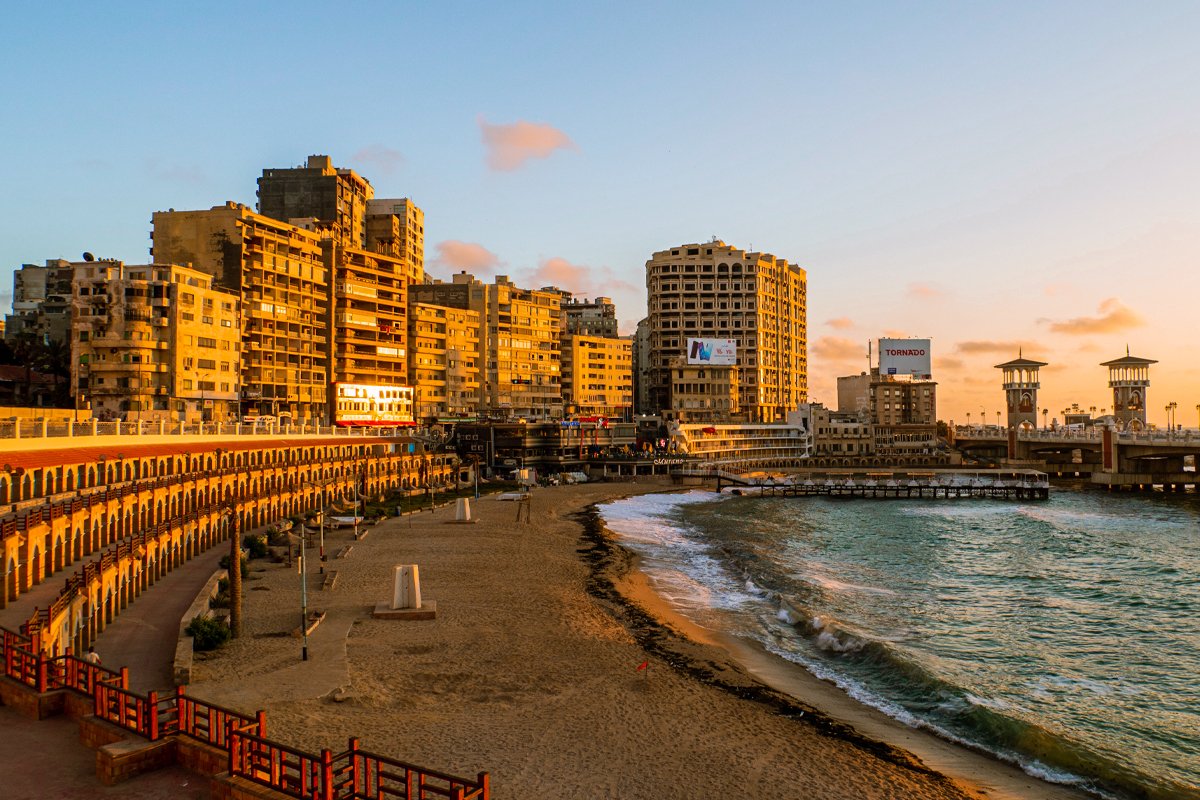
The core attractions of Alexandria are grouped into a surprisingly small area, most of them within a few kilometres of the Corniche, the long seaside promenade that curves along the eastern harbour. With disciplined timing and a sensible order, it is entirely realistic to see the great majority of the city's highlights in a single day. What follows are the essential things to do in Alexandria, arranged roughly in the order that works best for a day trip that begins early and ends with the sun over the sea.
Qaitbay Citadel: The Fortress on the Site of the Pharos
Start your morning at Qaitbay Citadel, the stone fortress that occupies the point where the Lighthouse of Pharos once stood. Built in the fifteenth century by Sultan Qaitbay using stone salvaged from the ruined lighthouse, it has protected the western entrance of the harbour for over five hundred years. It sits at the tip of the ancient Pharos island, joined to the mainland by a causeway long ago, so you can walk right out to it along the harbour wall. The views from the ramparts are among the best in Alexandria: across the western harbour, along the Corniche, and far out over the Mediterranean. Inside, a modest maritime museum displays anchors, amphorae, and naval artefacts, but the real attraction is standing on the windblown battlements where one of the seven wonders once blazed its nightly signal. Give yourself about an hour here, including time to wander the point and photograph the fishing boats below.
Bibliotheca Alexandrina: The Library Reborn
A short drive along the Corniche, the Bibliotheca Alexandrina is the spiritual successor of the ancient library and the single most impressive modern building in the city. Opened in 2002, the complex is dominated by a vast, tilted granite disc, symbolising the sun rising over the sea, with walls inscribed with characters from more than a hundred writing systems. Inside, the main reading room is one of the largest in the world, a terraced space lit from above, holding millions of volumes. Visitors can walk through the reading halls, explore the excellent antiquities museum in the basement, which holds artefacts recovered from under the city and from underwater excavations, and view galleries devoted to the history of Alexandria and its rare manuscripts. The planetarium next door is popular with families. Plan to spend at least ninety minutes here; it is the most compelling reason many travelers give for making an Alexandria day trip.
Catacombs of Kom El Shoqafa: A City of the Dead
Descend beneath the city and you enter one of the most extraordinary sights in the Mediterranean world. The Catacombs of Kom El Shoqafa, discovered by accident in 1900 when a donkey fell through the ground, are a three-tiered Roman-era necropolis cut into the bedrock, dating from the second century AD. Built for a wealthy family and expanded into a burial complex used for generations, they blend Egyptian, Greek, and Roman styles in a way that exists nowhere else. At the bottom of a deep spiral staircase, a rotunda with a shaft once used to lower bodies, a triclinium where funeral feasts were held, and a series of painted tombs await. The most famous image is the two statues of the jackal-headed god Anubis dressed as a Roman centurion, a perfect symbol of Alexandria's blended identity. The air is cool and the lighting is atmospheric, and the sheer depth of the descent makes this an experience you will remember long after the trip. Allow forty-five minutes to an hour, and be prepared for many steps.
Pompey's Pillar: The Last Great Column
A few streets inland, on a low ridge that was once the site of the Serapeum, the great temple of the god Serapis, stands Pompey's Pillar. Despite its name, the pillar has nothing to do with Pompey; it was erected around 297 AD in honour of the Emperor Diocletian, and the name simply stuck. It is a single column of red Aswan granite about twenty-five metres high, one of the largest monolithic columns of the ancient world, standing almost alone as a solitary survivor of a temple complex that once rivalled any in Egypt. Around it lie the ruins of the temple foundations, a few sphinxes, and the broken sphinxes that once lined the approach. Because the site is elevated, it offers clear views toward the sea. Pompey's Pillar takes only about thirty minutes to see properly, which makes it a perfect quick stop; photographs consistently fail to convey how tall it truly is.
Roman Amphitheatre and Kom El-Dikka: A Slice of Roman Alexandria
Not far from Pompey's Pillar, in the archaeological site of Kom El-Dikka, you will find the Roman Amphitheatre, the only Roman amphitheatre known in Egypt. Excavated in the 1960s, it is a small, elegant auditorium of white and grey marble with thirteen tiers of seating arranged in a semicircle, designed for music and poetry rather than gladiatorial combat. The site also includes the remains of Roman baths, with their original hypocaust heating systems, and the ruined lecture halls that scholars now believe were part of a university complex. Walking the tiered seats and climbing to the top for a view of the excavations is a compact, deeply atmospheric experience. The site deserves about forty-five minutes to an hour, and it pairs naturally with Pompey's Pillar, which lies within walking distance on the same ridge.
Alexandria National Museum: The City's Story in One Building
Housed in a restored Italianate villa that once belonged to a wealthy wood merchant, the Alexandria National Museum is the best place in the city to understand everything you have seen. Its collections are arranged on three floors that descend through time: the basement is devoted to the Pharaonic era, the ground floor to the Greco-Roman period, and the upper floor to the Coptic and Islamic eras, ending with artefacts from the nineteenth and twentieth centuries. The museum is famous for displaying treasures recovered from the sea, including material from underwater excavations of the ancient harbours, along with everyday objects that bring Alexandria's people to life. Because the collection is thoughtfully curated and the building is small, you can move through it in about an hour, and doing so near the end of your sightseeing will make everything you visited earlier fall into place.
Montazah Palace and Gardens: Green Escape on the Sea
To the east of the city centre, past the beachfront resorts, the Montazah Palace complex offers a completely different side of Alexandria. The palace itself, a mixture of Florentine and Ottoman styles built as a royal summer residence, is not open to the public, but the surrounding gardens most certainly are, and they are glorious. Rolling lawns, palm groves, ornamental bridges, and a small headland with wooden beach huts line the shoreline, and the whole park is open to the sea on two sides. It is where Alexandrians themselves go to stroll, picnic, and watch the sun go down, and on a day trip it is the ideal final stop, soft and green and cool after the heat of the monuments. Give yourself at least an hour to wander, longer if you want to sit by the sea with a cup of tea before the drive back to Cairo.
| Attraction | Highlight | Time Needed |
|---|---|---|
| Qaitbay Citadel | Fortress built with stones of the ancient Pharos lighthouse; panoramic sea views from the ramparts | About 1 hour |
| Bibliotheca Alexandrina | Vast modern library, antiquities museum, and galleries of Alexandria's history | 90 minutes or more |
| Catacombs of Kom El Shoqafa | Underground Roman-era tombs blending Egyptian and Roman art, including Anubis as a Roman soldier | 45 minutes to 1 hour |
| Pompey's Pillar | Giant monolithic column on the site of the Serapeum temple | About 30 minutes |
| Roman Amphitheatre at Kom El-Dikka | Marble auditorium and Roman bath remains in the heart of the city | 45 minutes to 1 hour |
| Alexandria National Museum | Curated collection of Pharaonic, Greco-Roman, Coptic, and Islamic treasures in a restored villa | About 1 hour |
| Montazah Palace and Gardens | Royal palace gardens on the Mediterranean; lawns, palms, and sea views | 1 hour or more |
A Sample Alexandria Day Trip Itinerary
How you order your day depends on whether you are travelling independently or with a guide, but the following schedule is a proven template that most visitors can follow comfortably. It front-loads the famous sights in the morning, when the light is soft and the crowds are thin, saves the museum for the heat of the afternoon, and ends with the gardens and the sea. It is also almost exactly the shape of the private Alexandria day trip that Maddy Tours Egypt runs from Cairo, so you can use it as a checklist no matter how you choose to travel.
| Time | Activity |
|---|---|
| 7:00 am | Depart Cairo by private car, train, or bus, heading north on the Alexandria Desert Road |
| 10:00 am | Arrive in Alexandria; begin at Qaitbay Citadel on the site of the ancient lighthouse |
| 11:15 am | Drive along the Corniche to the Bibliotheca Alexandrina and tour the library and its museums |
| 12:45 pm | Visit the Catacombs of Kom El Shoqafa and descend into the ancient necropolis |
| 1:45 pm | Stop at Pompey's Pillar for photographs, then continue to the Roman Amphitheatre at Kom El-Dikka |
| 2:30 pm | Lunch: fresh seafood by the harbour or a traditional meal in the city centre |
| 3:45 pm | Tour the Alexandria National Museum to put the day's sights into historical context |
| 5:00 pm | Relax in the Montazah Palace gardens; enjoy tea and sea views |
| 6:00 pm | Begin the return drive to Cairo, arriving in the evening |
Obviously, this schedule is aspirational at the edges, and every traveler will move at their own pace. If you linger over lunch or the library absorbs you for two hours, simply drop the museum or let the Montazah gardens become a short promenade. The beauty of an Alexandria day trip is that even a compressed version of this plan leaves you feeling that you have genuinely seen the city. A guided tour smooths the timing, because your driver meets you at each point and your guide has arranged entry, so the gaps between sights shrink to almost nothing.
Seafood and Café Culture: Where to Eat in Alexandria
Alexandria is the seafood capital of Egypt, and no day trip is complete without a proper coastal meal. The city's fishing fleet unloads its catch every morning, and by midday the restaurants along the harbour are grilling, frying, and baking a wonderful variety of fish: whole sea bass, sea bream, grouper, mullet, shrimp, calamari, and the small fried fish that Alexandrians eat like popcorn. A classic order starts with a mixed plate of fried and grilled fish, a heap of rice and salad, fresh bread, and tahini, and the portions are generous by any standard. Near the market you will find dozens of fish restaurants, from simple rooms where the day's catch is displayed on ice to long-established houses known for their spice blends and their skill over the charcoal grill.
The city also has a celebrated café culture that stretches back to its golden age. The great old coffeehouses, some operating for more than a century, are where Alexandrians gather to argue about football, read the papers, and nurse small glasses of strong black tea or Turkish coffee. One of the most famous is the Elite Café in the downtown district, an art-deco institution where writers and politicians once held court. Nearby, pastry shops display the sticky, nut-filled sweets and the ice cream for which the city is known, and a walk past their windows in the afternoon light is one of the simplest pleasures Alexandria offers.
For a full day in Alexandria, resist the temptation to skip lunch for sightseeing. The seafood lunch is not a fuel stop; it is an attraction in its own right, and it gives you a welcome rest between the morning's monuments and the afternoon's museum. Begin your meal the Alexandrian way with fresh juice or a small soup, order fish by the kilo so you can see exactly what you will be eating, and finish with strong coffee and a sweet. Vegetarians will find plenty of classic options too, from foul and falafel breakfasts to stuffed vegetables. Wherever you eat, ask what is freshest, trust the house seasoning, and let the sea set the menu.
And because a day trip has its own rhythm, plan for coffee twice: once in the morning when you arrive to shake off the drive, and once in the late afternoon by the water, ideally on the Montazah headland or at a Corniche café with the sun dropping toward the horizon. There is no better way to end a day in Alexandria than sitting with a drink, watching the fishing boats come in, with the desert road still ahead but the Mediterranean behind your shoulder.
Extending Beyond the City: An El Alamein Day Trip Option
If you have more than a single day, or if you are a keen student of military history, El Alamein makes a powerful addition to the coast. The town lies about two hours west of Alexandria along the Mediterranean highway, and its name is inseparable from the great battles of the Second World War. In 1942, the Allied forces under the British Eighth Army stopped the advance of the German and Italian armies at El Alamein, and the victory that followed that autumn marked the turning point of the North African campaign. The area today is a place of remembrance, dominated by beautifully maintained war cemeteries for the Commonwealth, German, and Italian soldiers who fell in the desert fighting, along with a small but deeply affecting military museum.
Because El Alamein is roughly two hours from Alexandria, it is usually combined with an overnight stay or approached as its own full day from Cairo, rather than bolted onto an already-packed single day. If the desert war fascinates you, the classic structure is to spend your first day on the Alexandria highlights, sleep by the coast, and then take the short drive west the following morning. The Commonwealth cemetery, with its long white ranks of headstones facing the sea, is one of the most moving memorials in North Africa, and the silence there is absolute. For most visitors, though, the priority remains the city itself, and El Alamein is best treated as a bonus for a longer itinerary or a return visit rather than an essential part of a single day.
Overnight Stay or Alexandria Day Trip? How to Decide
For the majority of travelers, an Alexandria day trip is exactly the right amount of time: it delivers every essential sight, the seafood lunch, and the seafront atmosphere, all without a change of hotel or a second night of packing. The city's attractions are compact and its best meals are lunchtime meals, which suits a day trip perfectly. If your goal is to see the monuments and taste the city, you can do that in daylight hours and still be back in Cairo in time for dinner.
There are, however, good reasons to stay overnight. Alexandria is at its most atmospheric after sunset, when the Corniche lights up and the cafés fill with families and students, and many travelers find that an evening walk by the sea is the memory that lingers longest. An overnight stay also lets you eat dinner rather than racing back to Cairo, visit the markets in the morning when they are at their liveliest, and, if you stay a full extra day, take a short side trip to El Alamein or enjoy a slow morning at Montazah. Families with young children and travelers who dislike early departures tend to prefer a night on the coast, while those on tight schedules almost always choose the day trip.
The decision also comes down to how you are traveling. On a private guided tour, you can cover the full itinerary comfortably and still relax at the end of the day, because the logistics are handled for you. If you are traveling independently by train, an overnight stay removes the pressure of the return schedule. Whichever you choose, the practical advice is the same: if you stay overnight, book a hotel in advance during summer and holidays, when Alexandria fills with Egyptian vacationers, and if you return the same day, keep your eye on the clock and aim to be on the road by early evening, because traffic on the desert road thickens as night falls.
Practical Tips for a Smooth Alexandria Day Trip
No matter how carefully you plan, a few practical habits will make your Alexandria day trip noticeably smoother, and most of them cost nothing more than a little forethought.
- Carry Egyptian pounds in small denominations. Entry tickets, drinks from kiosks, and taxi fares are all paid in cash, and few places accept cards.
- Dress for the city, not the beach. Alexandria is a working, conservative city, and although the Corniche is relaxed in summer, a modest set of clothes, a hat, sunglasses, and comfortable walking shoes will serve you best at the monuments.
- Bring your passport or a clear photo of it. It is occasionally requested at ticketing desks, and a spare copy avoids any friction.
- Check opening hours before you go, especially on Fridays, during Ramadan, and on public holidays, when museum schedules shift.
- Photography rules vary by site. The Bibliotheca Alexandrina and the museums may charge a small fee for cameras or prohibit flash, so ask at the entrance and respect the rules.
- Allow time for traffic and parking. The Corniche can be slow even on ordinary weekdays, and parking near Qaitbay and downtown is scarce, which is one more reason a private driver pays for itself.
- Stay hydrated and eat early. A morning start, a proper seafood lunch, and plenty of water will carry you through the afternoon better than any shortcut.
These details sound minor, but travelers who follow them consistently report that their day unfolds exactly as planned, while those who skip them lose time to small problems that a little preparation would have prevented. Alexandria is a forgiving city, friendly and slow-moving in the best way, but a little forethought lets you spend your time looking at the sea.
Frequently Asked Questions About an Alexandria Day Trip
Travelers ask the same sensible questions again and again, so here are the answers in one place, covering distance, time, cost, and the practical realities of seeing Alexandria Egypt in a single day.
| Question | Answer |
|---|---|
| How far is Alexandria from Cairo? | About 220 kilometres. By car on the desert road the journey takes roughly three hours each way, while the train takes about two and a half hours. |
| Can you really see Alexandria in one day? | Yes. With an early start you can comfortably cover Qaitbay Citadel, the Bibliotheca Alexandrina, the Catacombs of Kom El Shoqafa, Pompey's Pillar, the Roman Amphitheatre, the National Museum, and the Montazah gardens. |
| Is it better to take a guided tour or travel alone? | A private guide and driver save the most time and energy, because transport, tickets, and ordering are handled for you. Independent travelers can manage with the train and taxis if they are comfortable with that. |
| What should I wear for an Alexandria day trip? | Comfortable, modest clothing, sturdy shoes for stairs and cobbles, a hat for the sun, and a light layer in winter, when the coast can be surprisingly cool and windy. |
| What is the best time of year to visit? | Spring and autumn are ideal. Summer is crowded with Egyptian holidaymakers, and winter is cooler and windier, though the sights remain open year-round. |
| How much money should I carry? | Take enough Egyptian pounds for entry tickets, lunch, drinks, and tips, plus a small buffer. Most tickets and all small cafés are cash only. |
| Can I visit El Alamein on the same day? | It is a stretch, because El Alamein is two hours west of Alexandria. It works better as a separate full day or as part of an overnight stay on the coast. |
| Is Alexandria safe for tourists? | Yes. Alexandria welcomes millions of visitors every year, and the sites, the seafront, and the restaurants are all geared to tourism. Use normal common sense with valuables and transport. |
Planning Your Alexandria Day Trip with Maddy Tours Egypt
An Alexandria day trip may be one day on the calendar, but it deserves to be planned like the small masterpiece it is: the right departure time, the right route, the right order of sights, and the right lunch table by the sea. That is exactly the kind of detail Maddy Tours Egypt builds into every excursion from Cairo. Our team knows the desert road, the morning rhythms of the Corniche, and the moments when each monument is at its most beautiful, and we handle the driving, the tickets, and the timing so that you can spend your energy on the experience itself. Whether you travel with us or on your own, this guide has given you the full picture of the things to do in Alexandria, from the fortress on the ancient harbour to the gardens on the sea.
Book your Alexandria day trip with Maddy Tours Egypt today, and let us turn three thousand years of history and one perfect Mediterranean day into the memory you will talk about long after you have returned home. The sea is waiting, the seafood is on the grill, and the desert road is short. We would be honoured to bring you to the city that Alexander built.